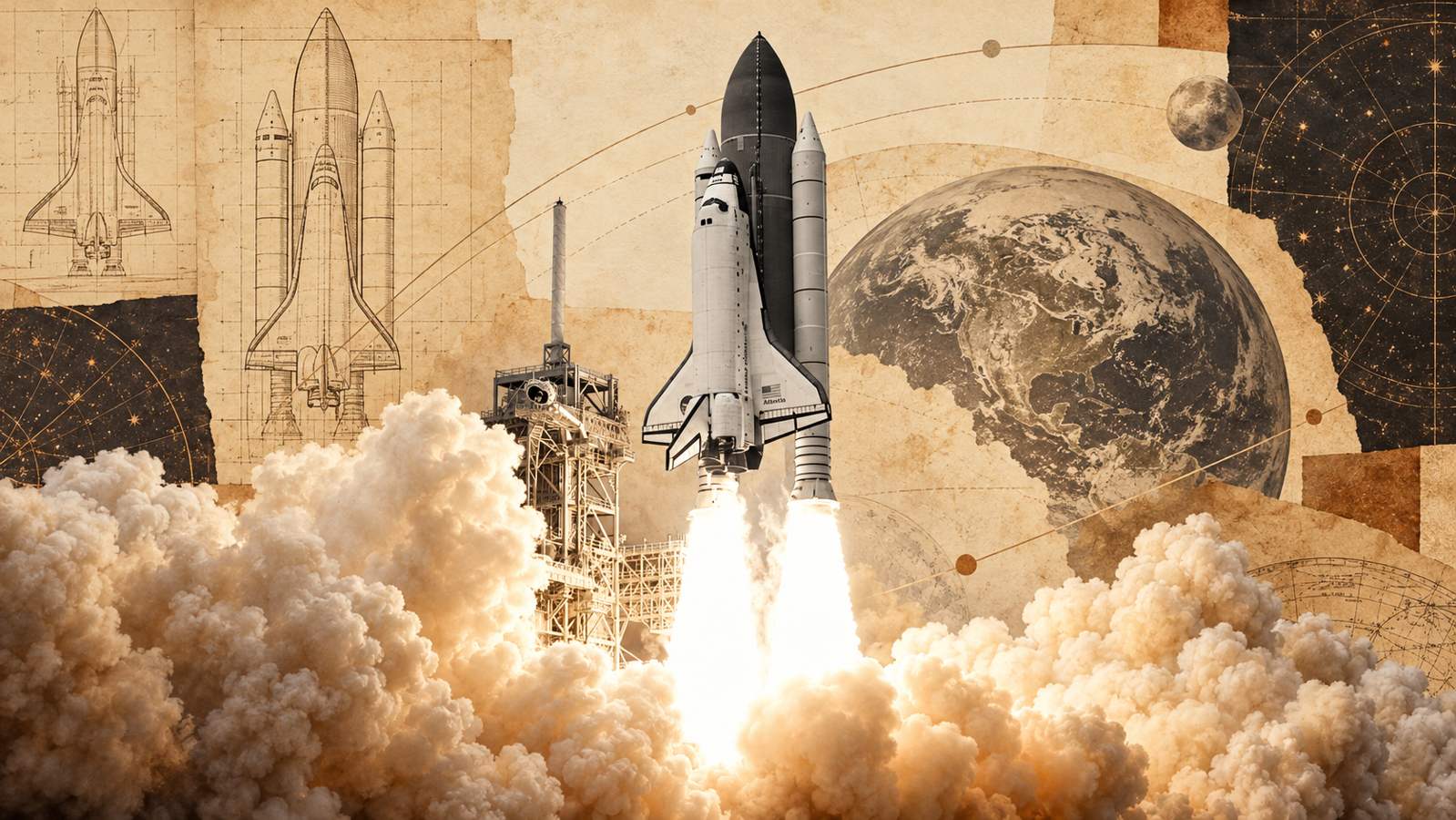
A rocket's ascent makes the difficulty of space travel visible, but the central engineering challenge extends beyond the flames. Delivering a payload to its intended orbit requires its position and velocity to be managed together. A rocket is therefore more than a vehicle that climbs: it is a system that establishes the initial conditions a space mission needs.
Thrust arises from the interaction between the rocket and the gas it expels. As the gas accelerates in one direction, the vehicle experiences a force in the other. Because surrounding air is not essential to this process, a rocket engine can operate in a vacuum. In chemical rockets, carrying the oxidizer required for combustion is another crucial aspect of that independence.
Orbital motion is equally liable to challenge everyday intuition. A satellite does not remain in orbit because it has escaped Earth's gravity. On the contrary, gravity continually bends its path. At an appropriate altitude and velocity, it falls while travelling around the planet. An orbit is thus a particular relationship between motion and gravity, rather than a region in which gravity has disappeared.
Establishing those conditions also depends on how the rocket manages its mass. Separating tanks and engines that have completed their function prevents later stages from having to accelerate unnecessary hardware. Separation, however, does not imply recovery. Staging and reuse are distinct design choices that address different problems.
For a recoverable stage, the end of a flight marks the beginning of another engineering process. After a controlled landing, its components are assessed, maintenance is performed and the vehicle is prepared to fly again. Landing successfully is an important link in that chain, but it does not by itself prove that reuse will be inexpensive or routine.
The economic advantage of reusability cannot therefore be assumed to be identical across all missions. Propellant reserved for the return, additional hardware, maintenance requirements and flight frequency must be considered together. There is also a distinction between demonstrating a technology with an experimental vehicle and establishing the efficiency of a system in regular service.
Changes in rocket technology should consequently be assessed through more than vehicle size or dramatic landing footage. A more meaningful criterion is how reliably a system delivers a payload to space and how sustainably its hardware can be prepared for further missions. The story concerns not only how a rocket reaches space, but also what makes its next journey possible.